
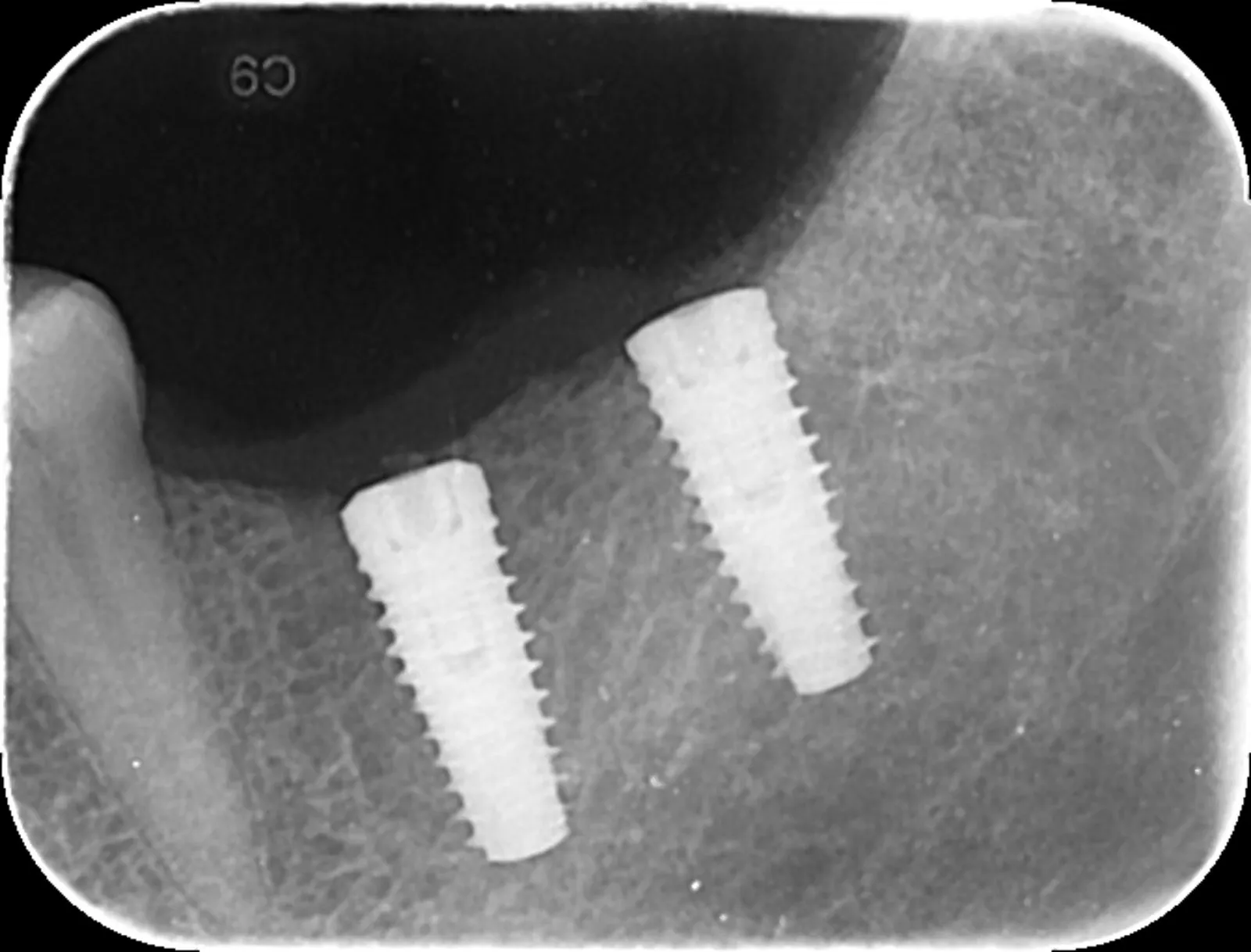
A dental implant is a titanium screw placed in the jaw where a tooth has been lost. Once it has fused with the bone, a crown or bridge is fitted on top, so the replacement looks and works like a natural tooth. If only one tooth is missing, an implant is the best solution, because the two neighbouring teeth do not have to be ground down for a bridge.
All-on-4
The All-on-4 concept means that the bridge replacing all the teeth in one jaw is fixed on just four implants. It suits patients with no teeth in the jaw, or those whose jawbone is not good enough (in thickness, width, height and density) for more implants. Four implants are the minimum that lets a patient have a fixed restoration instead of a denture. The fixed restoration is a 12-unit bridge with porcelain-fused-to-metal or zirconia crowns.
All-on-6
All-on-6 means placing six implants in the upper or lower jaw, which carry a bridge that replaces the missing teeth. The main requirement is good enough jawbone quality, so that each implant is stable. All-on-6 is the gold standard, because it gives the best distribution of chewing forces and the most stable fixed bridge.
A 3D scan (CBCT) is needed to assess the bone. Based on it, we draw up a treatment plan and suggest the solution that suits you best.
Hollywood smile
A Hollywood smile is a complete smile makeover: a prosthetic reconstruction of both jaws with zirconia crowns, veneers and often implants, in an ultra-white (bleach) shade.
When the existing teeth are only slightly damaged, evenly spaced and there is enough healthy tooth tissue, a perfectly white smile can be achieved with veneers. This is a minimally invasive procedure that preserves healthy tooth tissue.
More often, a Hollywood smile is created with crowns and bridges. For this, the patient needs at least half of their teeth to be healthy, and the rest to have healthy roots and enough tooth structure to carry crowns. Where several teeth are missing, a bridge is made, and where the arrangement of the teeth gives the bridge no support on both sides, implants are placed.
Treatment step by step
- Examination and a 3D scan of the jaw, then the treatment plan.
- Placing the implant under local anaesthetic: right after the extraction, 4–8 weeks later, or after six months of healing.
- The implant fuses with the bone (osseointegration), followed by a check-up X-ray.
- A gum former is fitted for 2–5 weeks.
- Impressions are taken and the final crown or bridge is made.
Read more in the article What are dental implants?, and about the surgical side on the oral surgery and implantology page.